Download
1 / 49
550 likes | 1.14k Views
Plant Anatomy. MUPGRET Workshop March 27, 2004. Definitions. Anatomy Study of form and basic organization. Morphology Study of tissue organization. Physiology Study of normal organism function. Life Cycle. Juvenile Adult Reproductive. Vegetative. Plant Structure.

E N D
Plant Anatomy MUPGRET Workshop March 27, 2004
Definitions • Anatomy • Study of form and basic organization. • Morphology • Study of tissue organization. • Physiology • Study of normal organism function.
Life Cycle • Juvenile • Adult • Reproductive Vegetative
Plant Structure • Two main organ systems: shoot and root • Shoot • Above ground • Leaves, buds, stems, flowers, fruits • Root • Below ground • roots, tubers, rhizomes
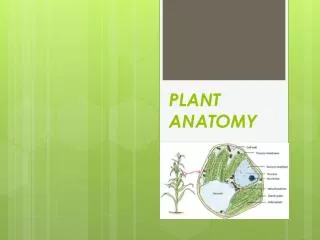
Plant Cells • Formed at meristems. • Mitosis in meristem produces new cells. • Two types of meristems. • Apical – produces primary growth, ex. tip of root or shoot. • Lateral – produces secondary growth, ex. cambium.
Cells are grouped into tissues. • Dermal • Ground • Vascular
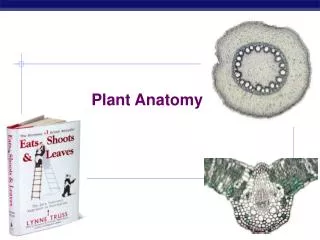
Cell Types Epidermal Ground Vascular Zea mays L. leaf cross section
Dermal Tissue • Covers outer surface of herbaceous plants. • Composed of epidermal cells that secrete the waxy cuticle. • Waxy cuticle protects against water loss.
Ground Tissue • Bulk of the primary plant body. • Composed of parenchyma, collenchyma, and sclerenchyma.
Parenchyma pineapple
Collenchyma Celery
Schlerenchyma hau – used to make rope
Vascular Tissue • Transports food, water, hormone, and minerals. • Composed of xylem, phloem, parenchyma, and cambium.
Xylem Dutchmens pipe Dicot stem
Vegetative Structures • Roots • Stem • Leaf
Roots • Tap root • Fibrous root • Adventitious root • Tuberous root • Aerial root
Roots Fiberous Tuberous Taproot Taproots
Stem Anatomy • Bud – undeveloped shoot. • Node – Location of leaf or bud on stem. • Internode – Space between nodes. • Pith – Spongy tissue in the center of the stem. • Lenticel – Pore in the outer layer of the stem.
Stem Modifications • Tuber – underground stem with nodes • Rhizome – underground stem with buds • Stolon – aboveground stem with shoot buds • Bulb – underground stem with fleshy leaves • Corm – underground stem with papery leaves
Modified Stem Tendril Thorn Onion set Rhizome
Modified Stem II Corm Asparagus Stolon
Growth Form • Herb • Shrub • Tree • Vine
Growth Cycle • Annual – single season • Biennial – two seasons • Perennial – multiple seasons • Evergreen – leaves persist > 2 seasons • Decidious – leaves die in cold or dry
Leaf Parts • Petiole • Blade • Stipule • Axillary bud
Leaf Structure Blade Stipule Petiole Axillary Bud
Leaf Arrangement • Alternate • Opposite • Whorled
Leaf form • Simple • Compound • Pinnate • Palmate
Vein Arrangement • Pinnate • Palmate • Parallel • Dichotomous Dichotomous
Ovate Elliptic Oblong Lanceolate Linear Orbicular Cordate Hastate Sagittate Peltate Perfoliate Terete Leaf Shape
Entire Serrate Doubly serrate Dentate Crenate Undulate Revolute Crisped Lobed Leaf Margins
Misc. Vegetative Structures • Thorns • modified stems (Honey Locust) • Spines • modified leaves (Cactus) • Prickles • epidermal outgrowth (Rose)
Reproductive Structures • Flowers • Fruits
Floral Parts • Pedicel • Sepal • Petal • Perianth • Stamen • Carpel • Pistil
Floral Symmetry • Actinomorphic • Many axes of symmetry, ie. the same wherever you cut it. • Zygomorphic • One axis of summetry, ie. can only cut one way.
Inflorescence Types Spadix Spikelet Solitary Spike Whorl Panicle Raceme Compound Umbel Umbel
Fruit Types • Dry, indehiscent fruit • Dry, dehiscent fruit • Fleshy fruit • Other
Dry, indehiscent fruits • Achene (lettuce) • Samara (maple) • Caryposis (wheat) • Nut (almond)
Dry, Dehiscent Fruit • Legume (soybean) • Capsule (tobacco) • Silique (Arabidopsis) • Schizocarp (maple)
Fleshy Fruits • Drupe (peach, nectarine) • Berry (tomato) • Pepo (cucumber) • Hesperidium (citrus) • Hip (rose) • Pome (apple, pear)
Other Fruit Types • Aggregate • mature ovaries from separate pistils of one flower (ex. raspberry) • Multiple • mature ovaries from separate pistils of several flowers (ex. pineapple) • Accessory • fruit is something other than ovary tissue (ex. strawberry is a swollen receptacle, seeds are achenes)
Placentation Axile Marginal Parietal Basal Free central Apical
Ovary Position Hypogynous (above calyx) Perigynous (within the floral cup) Epigynous (below calyx)
One cotyledon Parallel leaf veins Flower parts often in multiples of three Vascular bundles scattered in stem Two cotyledons Netlike leaf veins Flower parts often in multiples of 4 or 5 Vascular bundles in a ring in the stem Monocots vs. Dicots