Download
1 / 21
280 likes | 1.86k Views
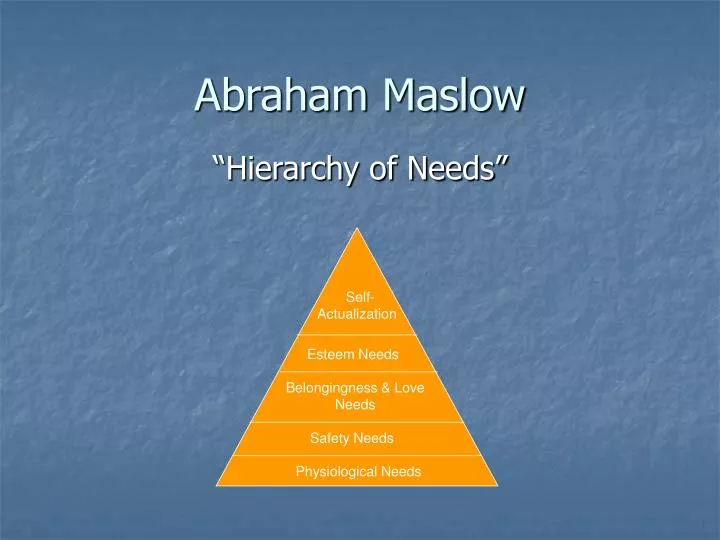
Self- Actualization. Esteem Needs. Belongingness & Love Needs. Safety Needs. Physiological Needs. Abraham Maslow. “Hierarchy of Needs”. ABRAHAM MASLOW. April 1, 1908 – June 8, 1970 1 of 7 children Jewish, parents uneducated Married Bertha Goodman, first cousin

E N D
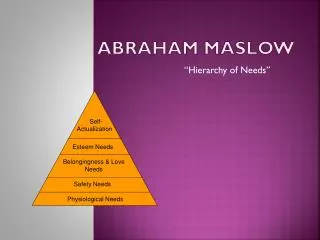
Self- Actualization Esteem Needs Belongingness & Love Needs Safety Needs Physiological Needs Abraham Maslow “Hierarchy of Needs”
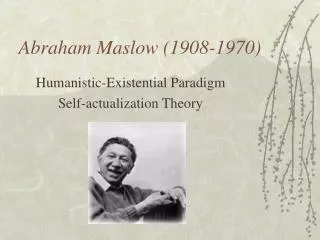
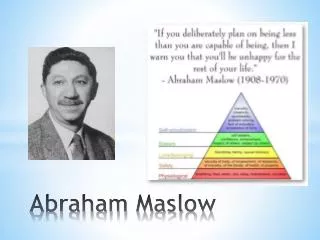
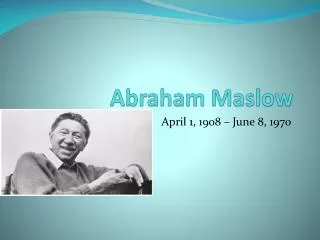
ABRAHAM MASLOW • April 1, 1908 – June 8, 1970 • 1 of 7 children • Jewish, parents uneducated • Married Bertha Goodman, first cousin • Received BA (1930), MA (1931) and PhD (1934) all from University of Wisconsin • Professor at Brooklyn College (1937-51) • and Brandeis University (1951-61) • Considered to be the founder of • humanistic psychology.
Read the following statements and tick those that apply to you. There are no right or wrong answers. __ A I am successful in life and/or work, and I’m recognized by my peers for being so. I’m satisfied with the responsibility and role that I have in life and/or work, my status and reputation, and my level of self-esteem. __ B I am part of, and loved by, my family. I have good relationships with my friends and colleagues - they accept me for who I am. __ C My aim is self-knowledge and enlightenment. The most important thing to me is realizing my ultimate personal potential. I seek and welcome ‘peak’ experiences. __ D I generally feel safe and secure - job, home, etc - and protected from harm. My life generally has routine and structure - long periods of uncontrollable chaos are rare or non-existent. __ E Aside from dieting and personal choice, I never starve through lack of food, nor lack of money to buy food. Aside from the usual trauma of moving house, I have no worry at all about having somewhere to live - I have ‘a roof over my head’.
Self- Actualization Esteem Needs Belongingness & Love Needs Safety Needs Physiological Needs Hierarchy Of Needs MASLOW’S
Hierarchy of Needs The hierarchy has five levels: • Physiological Needs: oxygen, water, protein, salt, sugar, calcium and other minerals and vitamins, shelter and sleep etc. • Safety Needs: security, stability, protection from physical and emotional harm • Belongingness & Love Needs: affection, belonging, acceptance, friendship, community • Esteem Needs:(Internal ones are need for self-respect, confidence, autonomy, and achievement. External ones are need for respect of others, status, fame, glory, recognition and attention.) Maslow feels these are the roots to many, if not most of our psychological problems. • Self-actualization: (doing that which maximizes one’s potential and fulfills one’s innate aspirations)
DEFICIT (D-NEEDS) • If you don’t have enough of something you have a “deficit” (need) • Maslow's hierarchy seems to follow the life cycle. A baby's needs are almost entirely physiological. As the baby grows, it needs safety, then love. Toddlers are eager for social interaction, attention and affection. Teenagers are anxious about social needs, young adults are concerned with esteem and only more mature people transcend the first four levels to spend much time self-actualizing. • Under stressful conditions, or when survival is threatened, we can “regress” to a lower level need.
BEING NEEDS (SELF-ACTUALIZATION) • Needs that do not involve balance • Once engaged, they continue to be felt • Continuous desire to fulfill potentials (“be all you can be”) • You need to have lower needs taken care of, at least to a considerable extent • Only a small percentage of the population is truly, self-actualizing (approximately 2%)
Maslow’s Theory and its Importance to Education • Teachers and administrators must consider student needs and their hierarchical order. • How teachers conduct a classroom is a major factor directing student’s motivation. • Teachers must know what their student’s needs are • Teachers must develop, encourage, enhance, and provide a means of stimulation in teaching programs.
Maslow’s Theory and its relation to Students Needs Physiological Needs: • Breakfast, lunch programs • Correct room temperature • Bathroom breaks • Drink breaks Safety Needs: • Well planned, structured lessons • Clearly defined processes, procedures, rules and practices • Fair discipline • Consistent expectations • Students feel free to take risks • Attitude of teacher (accepting, non-judgmental, pleasant, non-threatening) • Provide praise for correct responses instead of punishment
Maslow’s Theory and its relation to Students Needs Belongingness & Love Needs:(teacher-student relationship and student-student relationship) • Use one to one instruction • Use teacher conferencing • Get to know students (likes, dislikes, concerns) • Be available for students in need • Be supportive • Listen to students
Maslow’s Theory and its relation to Students Needs Belongingness & Love Needs:(teacher-student relationship and student-student relationship) cont. • Class discussions • Provide situations requiring mutual trust • Show and tell, sharing • Provide positive comments and feedback rather than negative • Teacher personality; empathetic, considerate, patient, fair, positive attitude
Maslow’s Theory and its relation to Students Needs Esteem Needs: (self-esteem) • Develop new knowledge based on background knowledge so as to help ensure success (scaffolding) • Pace instruction to fit individual need • Focus on strengths and assets • Take individual needs and abilities into account • Be alert to student difficulties • Be available and approachable • Involve all students in class participation and responsibilities • When disciplining, do as privately as possible
Maslow’s Theory and its relation to Students Needs Respect from Others: • Develop an environment where students are positive and non-judgmental • Star of the week, award program • Provide deserved positions of status • Involve students in activities of importance (clean up environment, food drive, etc.) • Recognition programs for special effort (helpful citizens of week) • Employ cooperative learning so as to develop trust between group members
Maslow’s Theory and its relation to Students Needs Self-Actualization: • Expect students to do their best • Give students freedom to explore and discover on their own • Make learning meaningful - connections to “real” life • Plan lessons involving meta-cognitive activities • Get students involved in self-expressive projects • Allow students to be involved in creative activities and projects
Solutions and Strategies for Sara With a ‘relaxed’ schedule at home – clarification from Sara’s mother is crucial. Physiological Needs: Sleeping and eating habits • Questions: 1. Were you aware that Sara stays up past 1 a.m.? 2. What is your evening routine at home? 3. How much time do you spend with Sara in the evening? • Solutions for Sara: 1. Proper meals in the morning and evening – who prepares the food – is the food nutritional – what is she eating? 2. Set bed times appropriate for age 3. Encourage more communication with Sara and her mother 4. Allow the children to have work breaks between class activities
Solutions and Strategies for Sara cont… Safety Needs: 1. Doesn’t feel free to take risks 2. Attitude of teacher 3. Provide praise for correct responses 4. Well planned structured lessons • Solutions for Sara: 1. Extra time for planning – teacher should be monitoring the time for each activity 2. Teacher needs to show more respect through positive reinforcement and praise 3. Fair instructions 4. Age/grade appropriate expectations 5. Non – threatening/pleasant
Solutions and Strategies for Sara cont… Love and Belonging Needs: 1. Positive reinforcement and comments (not – do it right!) 2. Teacher could try to be more sympathetic, empathetic, patient and fair 3. More communication with the teacher 4. Get to know Sara: her likes – dislikes Esteem Needs: 1. More peer tutoring should be used 2. Assign more in-class responsibilities to Sara
Solutions and Strategies for Sara cont… Self-Actualization: (once Sara gets to this level) 1. Teacher needs to use these things to maintain Sara at this level • Solutions: 1. Expect Sara to do her best 2. Give Sara freedom to explore & discover on her own 3. Make learning meaningful – connect to “real” life – TEACHER 4. Plan lessons involving meta-cognitive activities - TEACHER 5. Get Sara involved in self-expressive projects 6. Allow Sara to be involved in creative activities & projects
Read the following statements and tick those that apply to you. There are no right or wrong answers. __ E Aside from dieting and personal choice, I never starve through lack of food, nor lack of money to buy food. Aside from the usual trauma of moving house, I have no worry at all about having somewhere to live - I have ‘a roof over my head’. (PHYSIOLOGICAL NEEDS) __ D I generally feel safe and secure - job, home, etc - and protected from harm. My life generally has routine and structure - long periods of uncontrollable chaos are rare or non-existent.(SAFETY NEEDS) __ B I am part of, and loved by, my family. I have good relationships with my friends and colleagues - they accept me for who I am. (BELONGINGNESS & LOVE NEEDS) __ A I am successful in life and/or work, and I’m recognized by my peers for being so. I’m satisfied with the responsibility and role that I have in life and/or work, my status and reputation, and my level of self-esteem. (ESTEEM NEEDS) __ C My aim is self-knowledge and enlightenment. The most important thing to me is realizing my ultimate personal potential. I seek and welcome ‘peak’ experiences. (SELF-ACTUALIZATION NEEDS)
References • http://www.maslow.com/ • Myers, D.G. (1986) Psychology. (First Ed.) New York, New York: Worth Publishers. • http://www.pbs.org/wgbh/aso/databank/entries/bhmasl.html • http://www.ship.edu/~cgboeree/maslow.html • http://www.accel-team.com/human_relations/hrels_02_maslow.html • http://facultyweb.cortland.edu/andersmd/MASLOW/APPLY.HTML • http://chiron.valdosta.edu/whuitt/col/regsys/maslow.html • http://web.utk.edu/~gwynne/maslow.HTM
Thank you! Deb Jarvis Catherine McLeod Jeff Shultis Leslie Vanderburg Stacey Wigle