Download
1 / 20
1.03k likes | 5.95k Views
ABO Discrepancies. Dr. MH Saiemaldahr Blood Bank. ABO Antibodies. Generally IgM class antibodies For Group A and Group B persons the predominant antibody class is IgM For Group O people the dominant antibody class is IgG (with some IgM )

E N D
ABO Discrepancies Dr. MH Saiemaldahr Blood Bank drmsaiem
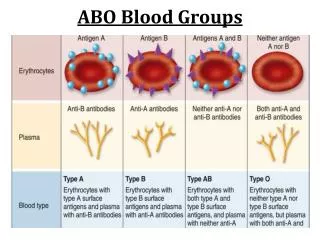
ABO Antibodies • Generally IgM class antibodies • For Group A and Group B persons the predominant antibody class is IgM • For Group O people the dominant antibody class is IgG (with some IgM) • React best at room temperature (22-24oC) or below in vitro. • Activates complement to completion at 37oC • Can cause acute Hemolytic Transfusion reactions • RBC Immune form: Predominantly IgG drmsaiem
ABO Antibodies • Time of appearance: • Generally present within first 4-6 months of life • Reach adult level at 5-10 years of age • Level off through adult life • Begin to decrease in later years: >65 years of age drmsaiem
A and B Subgroup They both react strongly with reagent anti-A. 80% of group A individuals phenotype as A1 20% phenotype as A2 Reagent anti-A is a mixture of two Abs ; • anti-A which react with both A1 and A2 cells. • anti-A1 which reacts with A cells but not with A2 cells in simple testing . drmsaiem
A and B Subgroup • Qualitative difference due to ; • 1-8 % of A2 and 22-35 % of A2B individuals produce a readily identifiable anti-A1 in their serum. • Quantitative difference • A2 cells carry 25 % as many Aantigen sites as do A1 cells • A1 individuals make A antigen from all type II chains ( H1-4 ) . • A2 individuals produce A antigen only from H1 and H2 precursors. drmsaiem
A and B Subgroup • Differentiation between the A blood subgroups • Reagent anti-A is a mixture of two Abs • The two Abs can be functionally separated by adsorption with A2 cells. • Anti-A1-lectin: is another source of anti-A1. • lectins are seed extracts that agglutinate human cells with some degree of specificity. • The seeds of the plant Dolichos biflorus serve as the source of the anti-A1 lectin this reagent agglutinate A1 orA1B cells but does not agglutinate A2 or A2B cells. drmsaiem
A and B Subgroup • Other A subgroups: RBC of the A int, A3, Ax, Ay or A cl. are only rarely seen in transfusion practice. • Subgroup of B: infrequent than the weaker subgroup of A, identified by anti-B and anti-A,B. Subgroups B3 , Bx , Bm and Bcl . drmsaiem
ABO Discrepancies • ABO discrepancies happen when there is no match in results between forward and reverse grouping. • ABO discrepancies are usually technical in nature and can be simply resolved by correctly reporting the testing and carefully checking reagents with meticulous reading and recording of results. drmsaiem
ABO Discrepancies • There are some ABO discrepancies that can happen due to technical errors and may lead to false positive or false negative reactions. • False positive reactions are due to; • Un-calibrated centrifuges • Contaminated reagents • Dirty tubes or glassware drmsaiem
ABO Discrepancies • False negative reactions can be due to many causes • Failure to add serum or reagents • Use of incorrect reagents or samples • Cell suspension is too heavy or too light • Inadequate identification of samples or test tubes drmsaiem
ABO Discrepancies • Group I discrepancies These discrepancies are between forward and reverse grouping due to weak reaction or missing antibodies. These kind of discrepancies are the most common. The reason for the missing antibody or weak reaction is that the patient has depressed antibody production or cannot produce the ABO antibodies. drmsaiem
ABO Discrepancies • This type of discrepancy can be seen in new born infants, elderly patients. • Patients with lymphoma. • Patients using immunosuppressive drugs. • Patients with immunodeficiency disease, BM transplant. drmsaiem
ABO Discrepancies • Resolving discrepancies • Eliminate all technical errors • Enhancing the reaction in reverse grouping • Incubate the patient’s serum with reagent cells at room temp. for 15 mins. drmsaiem
ABO Discrepancies Group II discrepancies These discrepancies are between forward and reverse grouping due to weak reaction or missing antigens. This group is the least one. Can be caused by some subgroups of A or subgroups of B or both. Also it can be present in patients with leukaemia and hodgkin’s disease. To resolve the problem wash the patient’s cells with saline. drmsaiem
ABO Discrepancies Group III discrepancies These discrepancies are between forward and reverse grouping due to protein or plasma abnormalities. These can be caused by elevated levels of globulin from certain diseases such as multiple myloma, hodgekin’s lymphoma. Some are caused by (Rouleaux formation). drmsaiem
ABO Discrepancies • Rouleaux or red cells result from a stacking of erythrocytes that adhere in a coin-link fashion giving the appearance of agglutination. • To resolve this kind of problem, washing the patient’s red cells with saline or adding a drop or two of saline to the tube in case of rouleaux formation. • If the agglutination is true red cell clumping will remain. • Cord blood must be washed 6-8 times in forward grouping ONLY. drmsaiem
ABO Discrepancies Group IV discrepancies • These kind of discrepancies are between forward and reverse groping due to miscellaneous problems. • Polyagglutination can occur due to exposure of hidden erythrocyte Ag. (T antigen) in patients with bacterial or viral infection. • Bacterial contamination in vitro or vivo produces an enzyme that alters and exposes the hidden Ag. on red cell leading to T activation. drmsaiem
ABO Discrepancies • Some examples of discrepancies • Example 1 • Forward grouping: anti-A =O, anti-B =O, anti-AB= O • Reverse grouping: A1 cells= O, B cells =O • Blood group: • O • Possible discrepancy: • Missing Ab. Or group I discrepancy drmsaiem
ABO Discrepancies • Example 2 • Forward grouping: anti-A = 4+,anti-B =O, anti-AB =4+ • Reverse grouping: A1 cells =1+, B cells =4+ • Blood group: • A • Possible discrepancy: • Missing Ag. Or group II discrepancy drmsaiem
ABO Discrepancies • Example 3 • Forward grouping: anti-A 4+,anti-B 2+,anti-AB 4+ • Reverse grouping: A1 cells 4+, B cells 4+ • Blood group : A • Possible discrepancy • Rouleaux formation drmsaiem